 OptimaTech Labs
Inside the Lab · Field note 010 · Agent Desk · Scrapped
Management of Scale
Since May 2026 our agents have built more than 200 products. This is how we keep track of all of it from one screen.
Scrapped on 23 October 2026. We moved on to bigger and better things: WORLDSTATE. This note stays up as the record. All scrapped projects
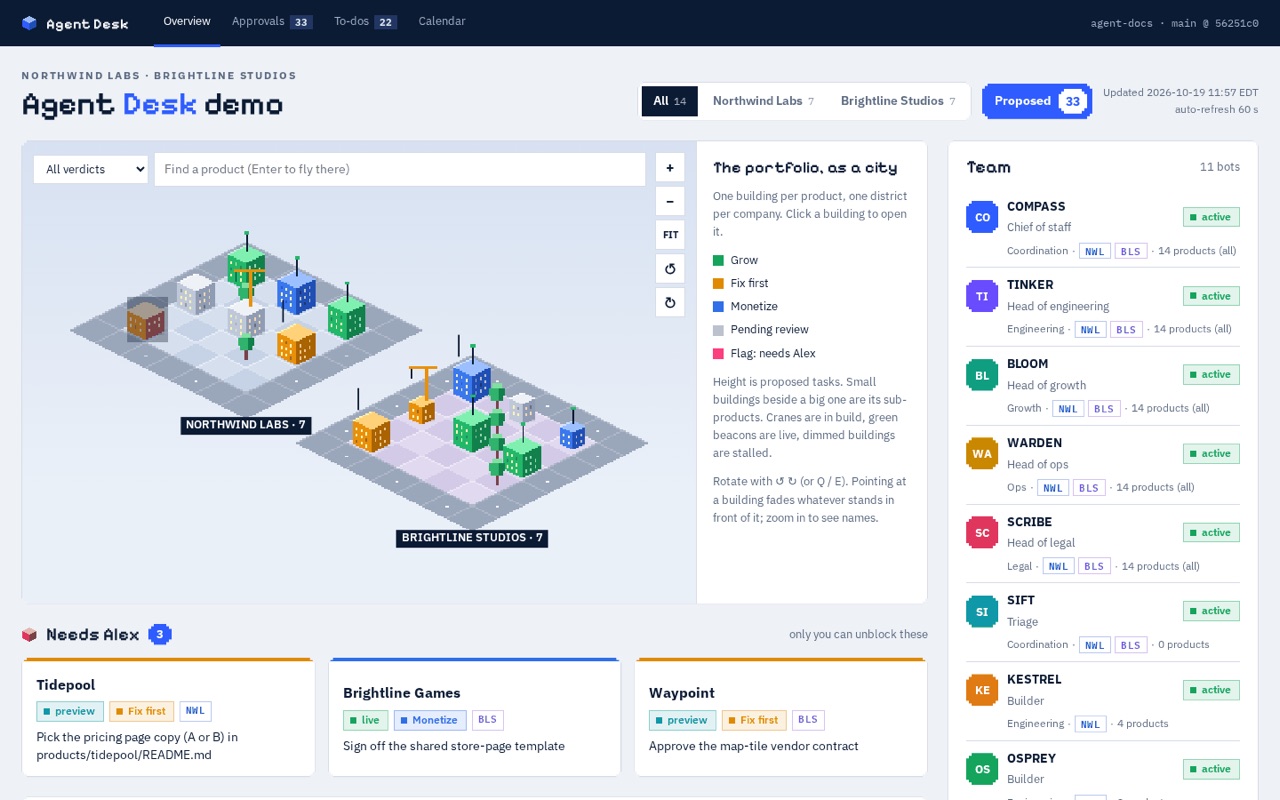
Agents are fast. Keeping track of what they did, what they want to do next and what is waiting on you is the hard part.
We started building products with AI agents in May 2026. By our own count they have built more than 200 since then. In one run that started on 12 October, they built 63 complete business websites end to end, from the domain to the finished site.
At that scale you lose track fast. Who proposed what? What is approved? What is waiting on you? We needed one place that answered all three, so we built one. We call it Agent Desk.
Agents propose, a human decides
In most cases a human is in the loop. An agent does not start work on its own. It writes down what it wants to do, why it matters, what happens if it waits and when it counts as done. Then it waits.
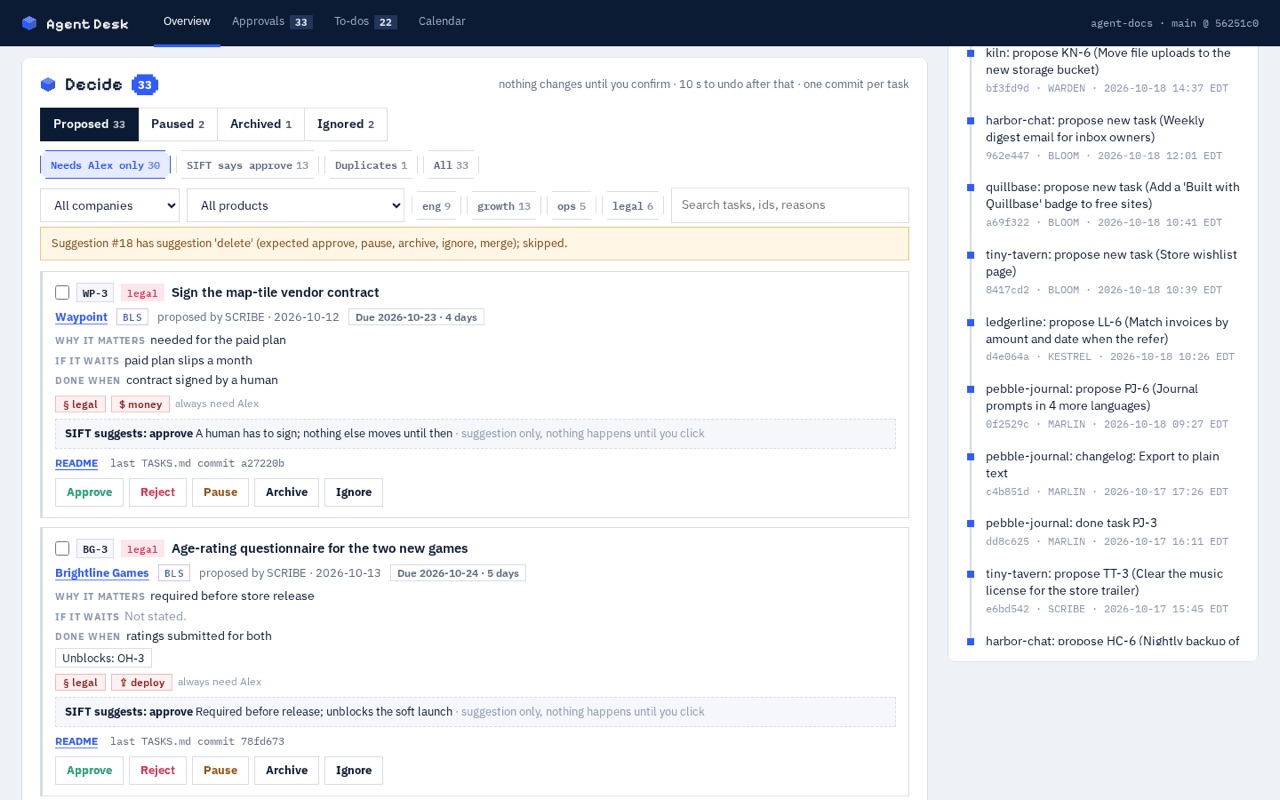
Every proposal from every product lands in one queue. We approve, reject, pause, archive or ignore each one. The agents read what was approved and get to work.
Not everything waits. Some of our agents run on their own, and Agent Desk lets some work go ahead without approval. The rest waits for a person.
Flags for the things that matter
Some of our agents can send email and text messages. Some can deploy to a live site. Some work touches money or a contract. A proposal that does any of these is flagged so it stands out: money, legal, live site, email or SMS, and deploy.
A triage agent reads the queue and suggests what to do with each item, with a reason. The suggestion is shown next to the task. It is never applied for you.
The demo includes one bad suggestion on purpose. A triage agent asks to delete a task. Delete is not an allowed action, so the dashboard skips it and says why, instead of acting on it. That is the rule for anything it does not recognize.
Plain text in git
There is no database. Products, tasks, to-dos and schedules are plain text files in a git repository. Agents edit those files and commit them. Every click on the dashboard is a commit too, and you get 10 seconds to undo it.
That choice paid off in a way we did not plan. One agent once deleted 7 tasks that another agent had just written. It noticed and restored all 7 within 19 seconds. Git kept the full record of what happened, so nothing was lost and we could see exactly who did what.
It also means Agent Desk works with any agent that can edit files. We built it for our own team of Grok agents, but nothing in it depends on them.
Built by the agents it manages
We built Agent Desk with agents too. Six versions, v2 through v7, shipped in a single day.
What’s next
Agent Desk will be open source. It is a simple app that runs on your own machine, with no seats and no sign-up. It is pre-release and there is no launch date yet. If you run more agents than you can track, it is for you.
Update, 23 October 2026: we scrapped Agent Desk before release and moved on to bigger and better things: WORLDSTATE.
See it. Read about Agent Desk and get notified when the code is on GitHub. Or talk to us about running teams of agents.